
Community Banking Matters | An OTMP Perspective
Merchant Services: From Website Listing to Growth Lever
Community banks face increasing pressure to deepen commercial relationships, grow deposits, generate non-interest income and differentiate themselves in an increasingly competitive marketplace.
Yet one of the most overlooked opportunities to support all four objectives too often receives less strategic attention than it should—merchant services.
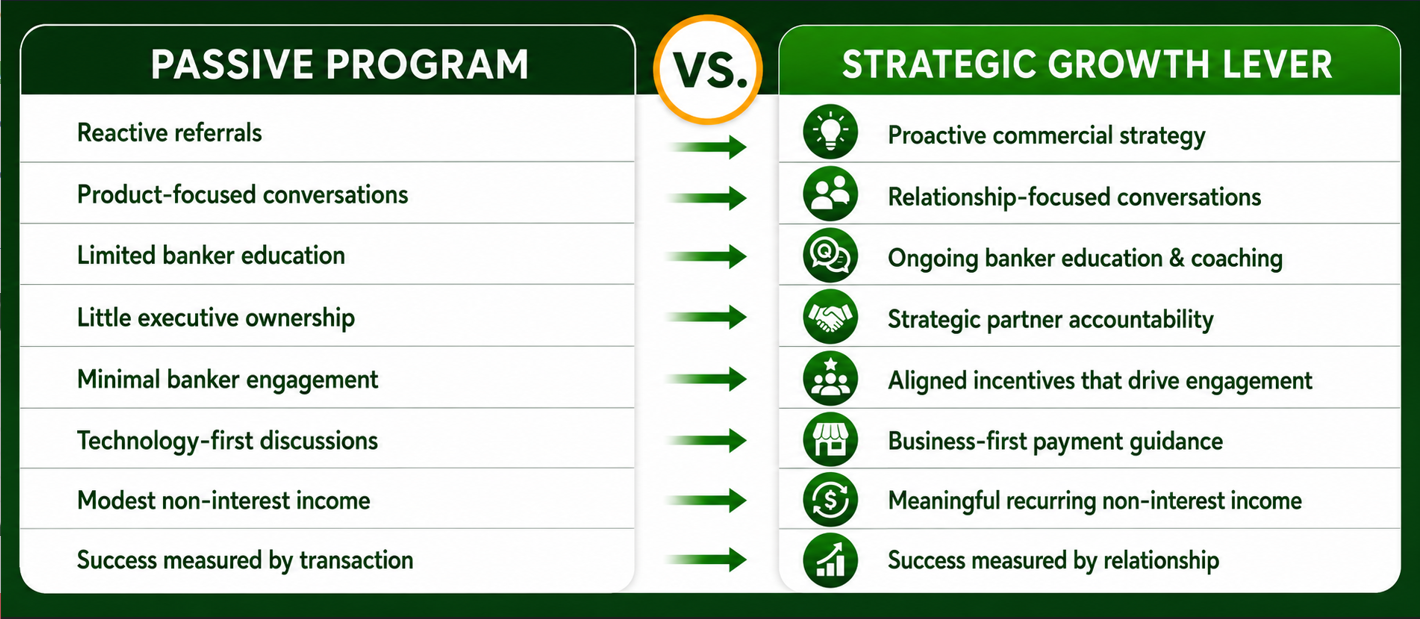
For many institutions, merchant services remains a passive offering. It is available when a business owner asks but rarely integrated with purpose into the bank's broader commercial banking strategy. Referrals are reactive, banker engagement is limited and the opportunity to strengthen the client relationship is missed. In some cases, new commercial and retail bankers receive little education or guidance on the institution's merchant services program. If the key people responsible for building business relationships aren't confident discussing the program, it's unlikely business owners will ever experience its full value.
But what if merchant services were viewed differently?
What if it became an intentional part of a bank's commercial banking strategy?
The Missed Opportunity
Merchant services is often evaluated through the lens of technology. Which terminal? Which point-of-sale system? Which gateway?
Those questions matter. But they don't tell you whether the program itself is working in the best interests of the bank, its people or its business customers. Technology alone does not drive a successful program.
Today's leading payment platforms provide robust technology, security, reporting, integrated solutions and payment capabilities. Technology has become the baseline—not the competitive advantage. The true differentiator is how a merchant services program strengthens the relationship between a bank and its business customers.
A Strategic Growth Lever
When approached strategically, merchant services becomes another reason for a banker to engage a business owner—not simply another product to offer. It creates opportunities to:
- Engage business owners in meaningful conversations about their operations.
- Create additional touchpoints that strengthen trust.
- Encourage businesses to maintain operating accounts and deepen their banking relationship.
- Generate recurring non-interest income.
- Demonstrate that the bank is invested in helping business clients succeed—not simply providing another product.
Merchant services should not sit on the sidelines of commercial banking. It deserves a seat at the table.
Why Many Programs Fall Short
From experience, the most successful merchant services programs are defined by leadership, education and engagement.
The strongest programs share important characteristics:
- Executive sponsorship and strategic focus
- Banker education and ongoing support
- Referral processes that are simple and well understood
- Incentive models that encourage engagement
- Marketing resources that reinforce the bank's brand
- A partner that operates as an extension of the bank's brand and understands the businesses, communities and geographic markets it serves
- A revenue-sharing model that produces meaningful recurring non-interest income
Without those elements, even the most sophisticated technology becomes just another product on a shelf.
A Different Perspective
A merchant services program should never be judged by the equipment it deploys. It should be judged by the commercial relationships it helps strengthen.
At OTM Payments, we've spent years partnering with community banks and have seen firsthand what happens when merchant services receives the same attention as other commercial banking initiatives.
The conversation changes.
Business owners receive meaningful guidance rather than generic sales presentations. Bankers gain another opportunity to strengthen trusted relationships. The institution benefits from deeper client engagement, stronger operating account relationships and recurring non-interest income.
Community banks distinguish themselves through relationships. Business owners choose them because they value access, responsiveness and trusted advice. A merchant services program should reinforce those same qualities—not operate independently from them. The technology may power the solution, but the relationship is what gives it lasting value.
A Question Worth Asking
Perhaps the better question isn't: "Do we offer merchant services?”
Perhaps it's: "Are we intentionally leveraging merchant services to strengthen commercial relationships, support our business clients and create measurable value for the bank?”
The answer may reveal one of the greatest untapped opportunities within community banking today.
DOWNLOAD the full PDF here: Community Banking Matters Issue 1
